LLC vs Sole Proprietor vs S-Corp for Shopify, Etsy & TikTok Sellers (And When to Switch)
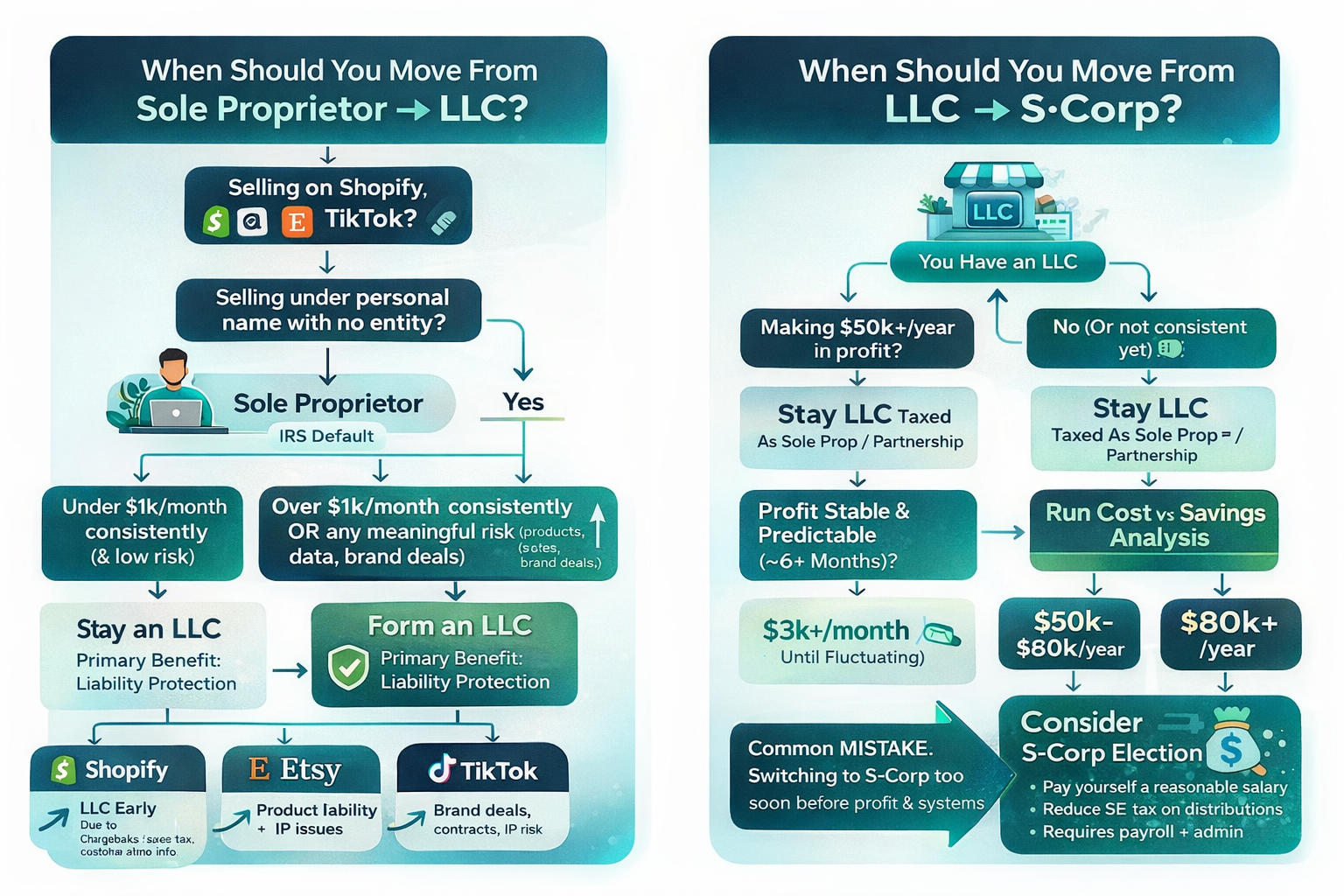
Short answer: most online sellers start as sole proprietors by default, but that structure quickly becomes inefficient—and risky—once revenue or exposure increases. For U.S.-based sellers on Shopify, Etsy, and TikTok, the optimal path is usually sole proprietor → LLC → S-Corp, with timing based on profit, not hype.
Key Statistic
The IRS imposes a 15.3% self-employment tax on sole proprietors and default LLCs (12.4% Social Security + 2.9% Medicare) on net earnings, before income tax.
Under $1k/month
Sole Prop OK
$1k-$3k/month
Form an LLC
$50k-$80k+ profit/year
Elect S-Corp
How Does a Sole Proprietorship Work for Ecommerce Sellers?
A sole proprietorship is the default business structure when you sell online without forming an entity. If you open a Shopify store, list products on Etsy, or earn TikTok Shop commissions under your own name, the IRS treats you as a sole prop.
What this means for sellers:
- You report income on Schedule C with your personal tax return
- You pay income tax + 15.3% self-employment tax on net profit
- There is no legal separation between you and the business
Platform reality check: Shopify, Etsy, and TikTok Shop do not require an LLC or corporation to sell. However, they also provide zero liability protection if something goes wrong—product defects, IP claims, chargebacks, or lawsuits all flow to you personally.
When Should You Switch From Sole Proprietor to LLC?
Most ecommerce and creator sellers should consider forming an LLC once they consistently earn $1,000–$3,000 per month or the moment they introduce meaningful risk (physical products, customer data, brand deals).
Why LLCs matter for online sellers:
- Liability protection: separates personal assets from business liabilities
- Credibility: required by many wholesalers, payment processors, and brand partners
- Tax flexibility: an LLC can later elect S-Corp taxation
Decision Tree: Sole Proprietor → LLC
Platform-specific risk examples:
Shopify
Chargebacks, data privacy, sales tax exposure
Etsy
Handmade/product liability and IP claims
TikTok
Contracts, sponsorships, content ownership disputes
How Is an LLC Taxed for Online Sellers?
An LLC is a legal structure, not a tax structure. By default:
Single-member LLC
Taxed like a sole proprietorship (Schedule C)
Multi-member LLC
Taxed as a partnership
This is why many sellers say, "My LLC didn't save me on taxes." They're right—until a tax election is made. Without an S-Corp election, LLC owners still pay the full 15.3% self-employment tax on net profits.
Expert Perspective
"The LLC's real value initially is risk protection, not tax savings—tax optimization comes later."
What Is an S-Corp and Why Do Ecommerce Sellers Use It?
An S-Corporation is not a business type—it's a tax election you can make (usually after forming an LLC). The benefit is the ability to split income into:
Reasonable Salary
Subject to payroll taxes (15.3%)
Distributions
NOT subject to self-employment tax
This structure is especially powerful for:
- High-margin Shopify stores
- TikTok creators with sponsorship income
- Etsy sellers with consistent, predictable profits
At What Revenue Does an S-Corp Actually Save You Money?
The real threshold is profit, not revenue. For most sellers, an S-Corp starts making sense around $50,000–$80,000/year in net profit.
Example: $80,000 Net Profit
As an LLC (default)
~$12,240
in self-employment tax
As an S-Corp
$45,000 salary → payroll taxes apply
$35,000 distribution → no SE tax
~$5,000–$7,000
estimated annual savings
Decision Tree: LLC → S-Corp
Common Mistake
"The biggest mistake we see is sellers electing S-Corp status too early—paying more in payroll and compliance than they save in taxes."
Platform Comparison: Does It Change the Best Entity?
Yes. Platform economics and risk profiles matter.
| Platform | Typical Risk Profile | Entity Recommendation |
|---|---|---|
| Shopify | Inventory, sales tax, chargebacks | LLC early; S-Corp at scale |
| Etsy | Product/IP liability | LLC as soon as sales are consistent |
| TikTok Shop | Variable income, contracts | LLC early; S-Corp once profits stabilize |
Key insight: TikTok creators often benefit from S-Corps sooner only if income is consistent and high-margin.
LLC vs S-Corp vs Sole Proprietor — Side-by-Side Comparison
| Feature | Sole Proprietor | LLC | S-Corp |
|---|---|---|---|
| Liability protection | |||
| Self-employment tax | Full | Full (default) | Reduced |
| Payroll required | |||
| Best for | Very small sellers | Growing sellers | Profitable sellers |
Common Mistakes Ecommerce Sellers Make
Confusing revenue with profit
Electing S-Corp too early
Waiting too long to form an LLC
Relying on one-size-fits-all formation services
Frequently Asked Questions
Sources Cited
- Internal Revenue Service. (2024). Self-Employment Tax (Schedule SE).
- Internal Revenue Service. (2024). S Corporations.
- U.S. Small Business Administration. (2023). Choose a Business Structure.
- Internal Revenue Service. (2023). Reasonable Compensation Guidelines.